Resolve the asset once. Read every document against it. Run every decision from the same state.
Every property, tenant, lease and counterparty read in place — nothing copied — into one governed graph. When documents disagree, AIState finds it, and your institution's own process runs to resolution.
The same building, three times over — and never together.
Real estate institutions run diligence, monitoring and valuation as separate exercises, each with its own data. The building checked at acquisition is not the building in the valuation model. The tenant assessed at signing is never looked at again. The market data behind a price is never connected to the regulatory, capital and supply context that decides whether it holds. What is missing is not a better model — it is the connected context the models never see.
The full AIState stack, pointed at property.
Read in place
Your systems and outside sources, read where they live. Discovered, catalogued and resolved — the same building across a registry reference, a broker's address and a portfolio code.
Derived, not drawn
The real estate ontology — property, lease, tenant, transaction, market, development, regulation — derived from what is found. Every attribute keeps its source.
Your expertise, your policy
Expertise encoded as agencies. Policy executed as Agentic BPMN — your thresholds, controls, routing and approvals — callable by any authorised agency.
AIState Real Estate
Four services on one graph, running inside your boundary under your keys.
Transactions · lease abstracts and leases · portfolio data · valuation history · counterparty records · facility agreements
Land and corporate registries · energy-performance and planning records · macro and rate data · listings · sanctions and PEP lists · adverse media · satellite imagery
Connects to what you already run — your property-management, valuation and lending systems, and the data you already license.
No source document, record or row is migrated; every system of record stays authoritative.
Documents, diligence, valuation and monitoring — from the same state.
Lease and document intelligence
Every obligation in every lease, amendment and side letter extracted as structured data and reconciled — heads of terms against the executed lease, amendments against the original, the rent roll against the leases, covenants against what is reported. Each contradiction starts the process your policy requires.
Diligence
Before the decision: tenants, landlords, sponsors, guarantors, lenders, operators and vendors resolved to who ultimately owns and controls them, and checked against your policy; assets checked for encumbrances, planning status and environmental compliance; the seller's rent roll checked against the data room.
Valuation context
The context conventional valuation models do not have: comparable evidence weighted by similarity and recency, lease quality across the tenant roll, capital-flow pressure, supply-pipeline risk, rate sensitivity, energy and stranding exposure, tenant concentration — delivered to your valuers and your models, every input traced to its source. It feeds your existing valuation models; it does not replace them. Residential valuation is supported on the same graph.
Portfolio monitoring
After the decision: assets, tenants, obligations and covenants watched continuously. Break dates, rent reviews and guarantee expiries become events; a tenant's parent in distress becomes an exposure; a change in a party's ownership or control, a new sanctions or PEP link, adverse information or a change in corporate status reopens the process your policy requires. Only material change is pushed, with its source and a before-and-after view.
Not a concept. Running on the platform today.
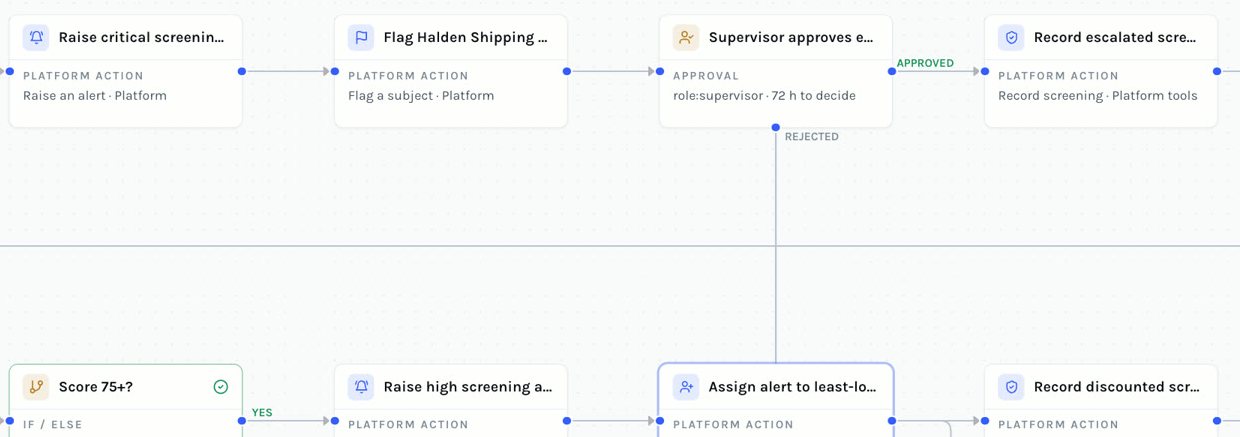
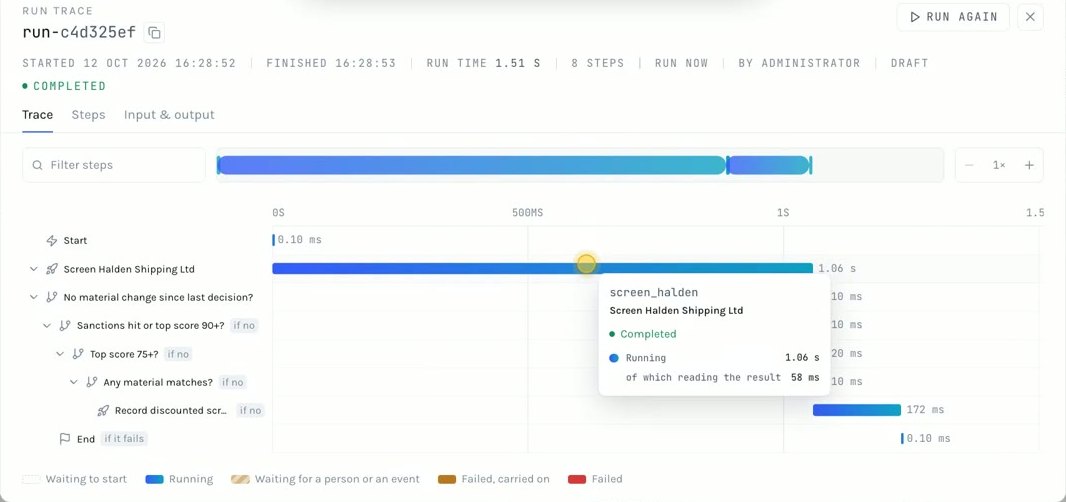
Screens from the live system, shown on synthetic data: a deed read across four versions, and a governed process built and run. The same screens read a lease, its amendments and its side letters.
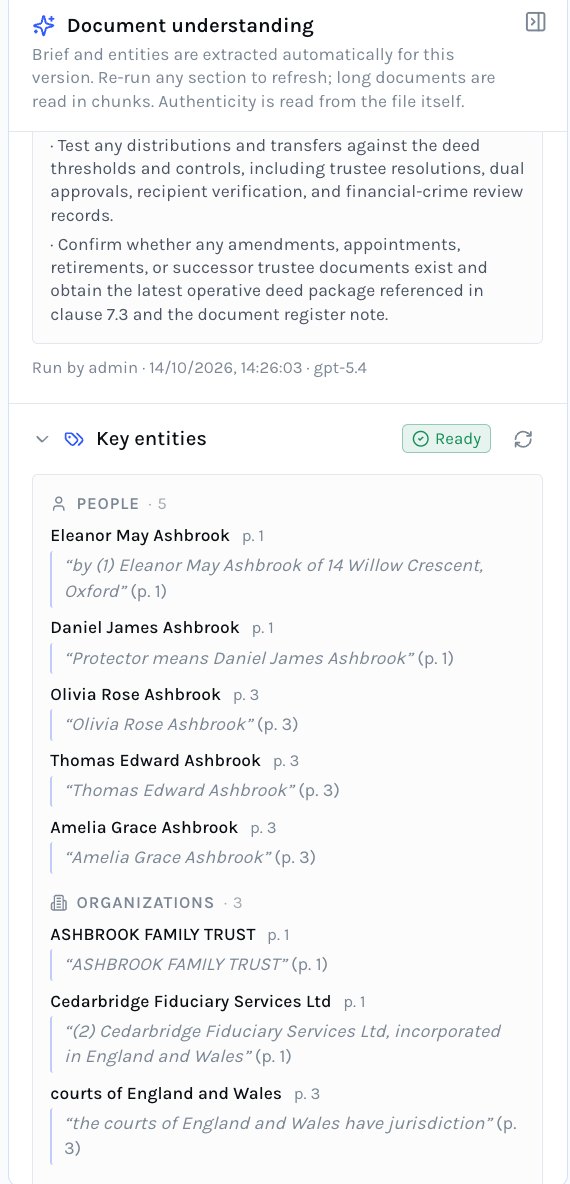
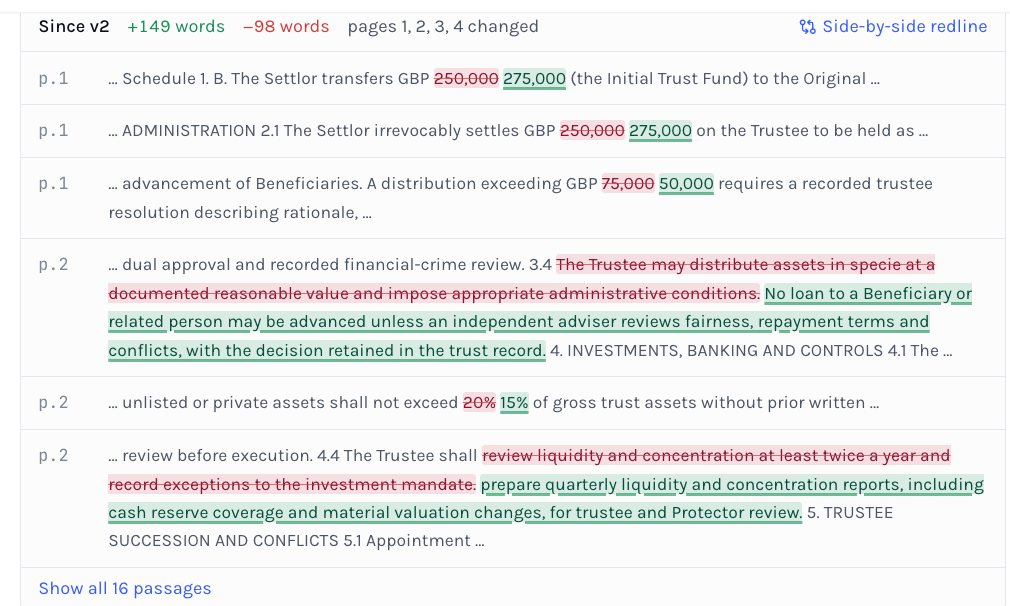
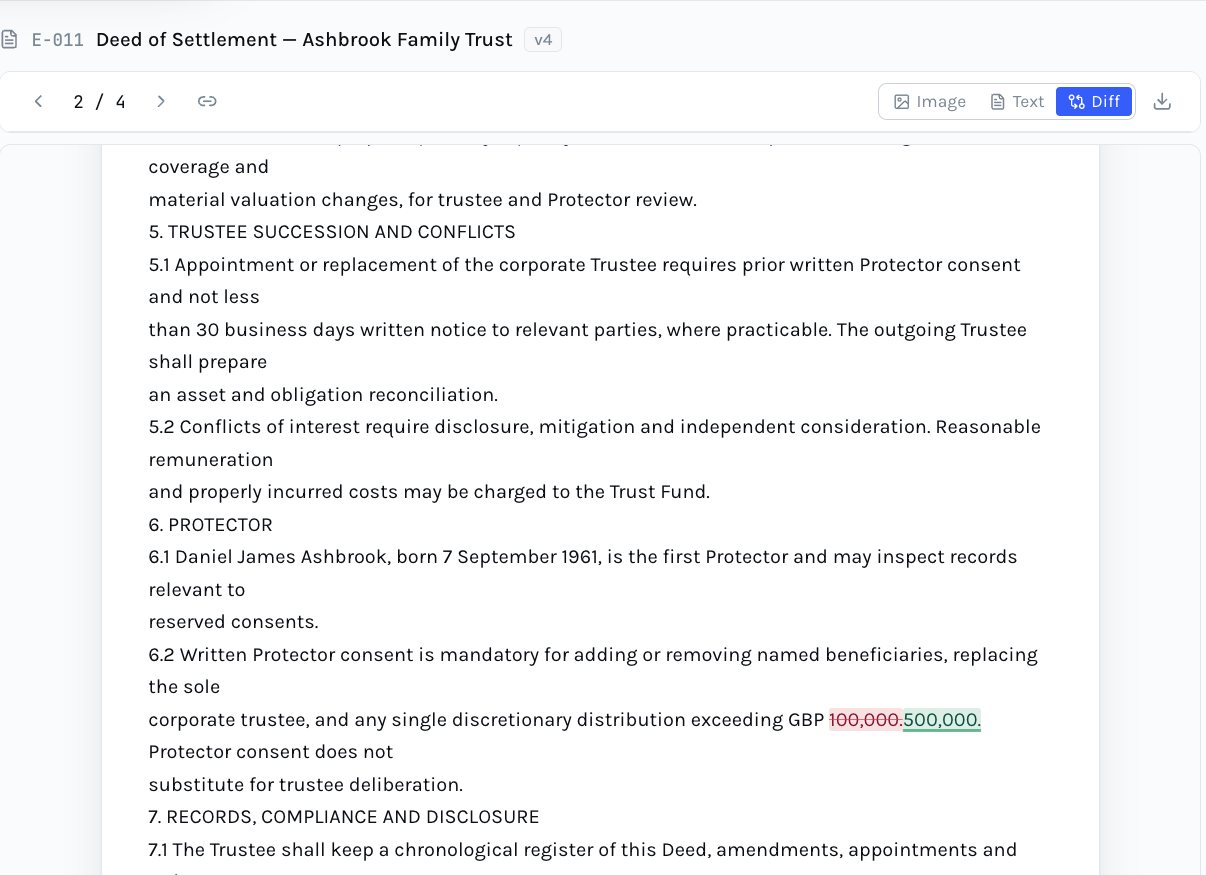
Every obligation extracted. Every contradiction named.
A property's value depends on documents nobody reads together. Terms drift apart — and the difference surfaces at a sale, a refinancing or a dispute, when it costs most.
- Obligations become data. Rent, review and indexation, break options and their conditions, repair and service-charge duties, use and assignment, guarantees — each with who is bound, must or may, the value, conditions, exceptions and the source quote.
- Compared by meaning, not wording. A six-month notice and a three-month notice is a contradiction however each clause is phrased.
- Named with evidence on both sides — across one lease's history or a whole portfolio against its rent roll.
- Landed in the graph on the right property, tenant and lease — not left in a spreadsheet.
Tenant may break on the fifth anniversary on six months' written notice.
Tenant may terminate on the fifth anniversary on three months' prior written notice.
Know the asset. Know the documents. Know the parties. Keep knowing.
An asset's state is not only the building, its leases and its rent roll. It is also who the institution is dealing with, and whether that relationship remains acceptable. Every decision on a property comes back to four questions, and AIState answers all four from the same resolved state, so none of them is answered twice or goes stale on its own.
What is this asset, and what is true about it?
The building, its leases, rent roll and title resolved once. Every document read against them; where they disagree, AIState finds it.
Who are we dealing with, and who controls them?
Tenants, landlords, guarantors, lenders, operators and vendors resolved from your systems and from registers, ownership data, watchlists and media, down to beneficial ownership and control.
What obligations and relationships exist?
Covenants, guarantees, consent rights, change-of-control terms and lender conditions connected to the parties they bind and the asset they sit on.
Has anything changed that affects our decision?
Parties and assets stay under watch. When something material moves, the state updates and your institution's process runs.
Party due diligence
At acquisition, leasing, refinancing or any event you define: the relevant parties resolved, the evidence gathered, ownership and control established, your checks run, and exceptions routed through your governed process.
Ongoing KYC and KYB
The decision is not frozen in a case file. Parties stay under continuous watch against the signals you set (ownership and control, sanctions and PEP exposure, adverse information, corporate status), and a material change reopens the right workflow.
The tenant's ultimate owner changes: a new parent group now holds 75% of the shares.
A change of control of the tenant is treated as an assignment and needs the landlord's prior written consent.
- Does the lease need consent? The change-of-control clause is read against the new ownership, not left for someone to remember.
- Does the guarantor still stand? The guarantee is checked against the new group structure.
- Has exposure shifted? Income dependent on the new owner's group is measured across the whole portfolio.
- Are lender covenants affected? Facility conditions tied to the tenant or the asset are surfaced.
- Does policy require enhanced due diligence? Your policy decides; the agency assembles the evidence, people decide where approval is reserved, and the decision becomes part of the asset's state.
Not an alert for someone to chase: your policy, run to resolution, on the same graph that holds the lease.
The risk that matters lives between the records.
A tenant's parent in distress
— and every asset in the portfolio whose income depends on it.
A counterparty two steps from a sanctioned owner
— found in the ownership chain before the deal, not after.
Lease breaks clustering in one quarter
— across a submarket, visible before the income falls away.
A development pipeline changing supply
— around an asset, before any valuation reflects it.
Agencies do the work. The process enforces the institution.
Policy executes itself
Materiality thresholds, approval routes, segregation of duties, evidence requirements, SLAs and escalation paths are properties of the running process — not instructions someone has to remember to follow.
Humans judge where judgement belongs
A valuer, an investment-committee member or an authorised decision-maker enters only where policy or professional responsibility reserves the decision to them — with the evidence in front of them.
The run is the control record
The audit trail is produced by execution itself — not reconstructed afterwards from email, notes and checklists.
AIState does not merely find the inconsistency. It knows what the institution must do about it.
Any authorised agency built in the Studio can invoke a governed business process; a process can in turn invoke agencies, other processes and human decision points. Your procedures become callable institutional capabilities — so an agency never improvises the next step.
Illustrative: the executed lease gives three months' break notice where the heads of terms gave six. The finding invokes the process; the process decides what happens next — and records it.
Resolve once. Utility many times.
The counterparty resolved for AIState Risk is the landlord, tenant or borrower in AIState Real Estate. Every service added makes the graph beneath the others richer.
What accumulates is yours.
Your transaction history, lease data, decisions and valuation record become your Artificial Proprietary Intelligence — owned by you, not handed to someone else's model.
One portfolio. Its leases against its rent roll.
Leases against the rent roll
Lease and document intelligence on one portfolio — every contradiction found, and the process it triggers run to resolution.
Parties, diligence and monitoring
Every party resolved to who controls it, diligenced and kept under watch; the extracted leases become watched obligations, read against any change in the parties they bind.
Valuation context and beyond
The same graph delivers valuation context, further portfolios and markets — each added without starting again.
Every asset resolved once — and every lease read in the context of the asset it governs.
The agency does the work. The process enforces the institution. People decide where judgement truly belongs — inside your boundary, under your keys.