AIState reads every system you run, and the outside sources you trust, where they live. It catalogues them, resolves them into one institutional knowledge graph, derives the ontology from what it finds, and lets your people encode what they know as agencies, inside your boundary, every write governed. We call it Artificial Proprietary Intelligence.
Databases, documents, SaaS, logs and outside sources are read in place and catalogued with lineage. Raw egress 0 B.
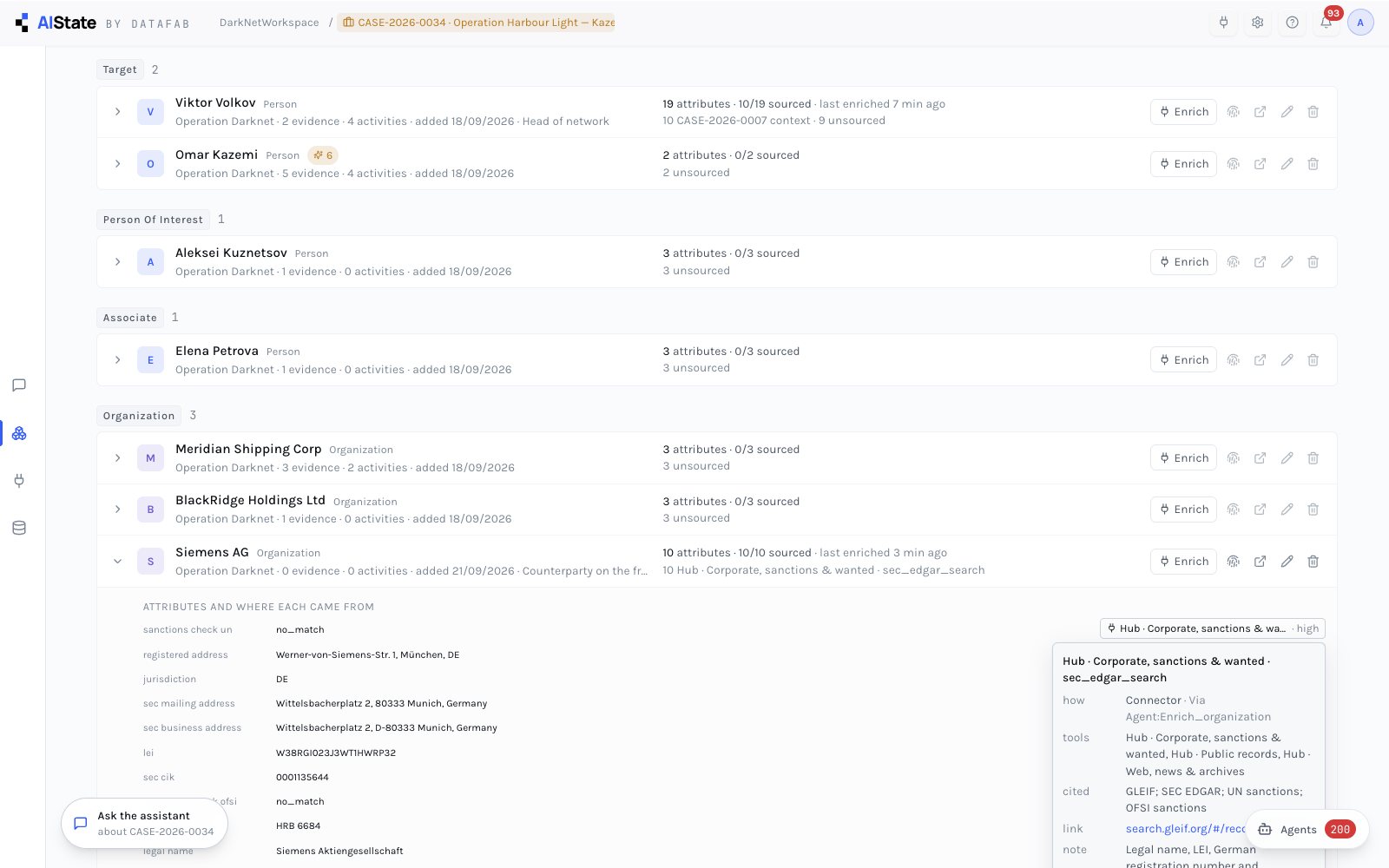
People, organizations, accounts and devices, resolved once, with source, citation and confidence on every value.
105 agencies ready and a Studio to compose more. Every write follows the autonomy you set; what you reserve waits until a person accepts it.
The Knowledge Fabric reads your databases, stores, documents, SaaS and feeds in place and resolves what they hold into a single knowledge graph. Your systems of record are read where they live: no source document, record or row is migrated, and every system of record stays authoritative. The records you choose to import — statements, transaction histories, device and system logs — are held as evidence under your key, because analysis has to be able to cite them. AIState renders that whole state as one picture your analysts can question, and agencies your own people compose work on it under review.
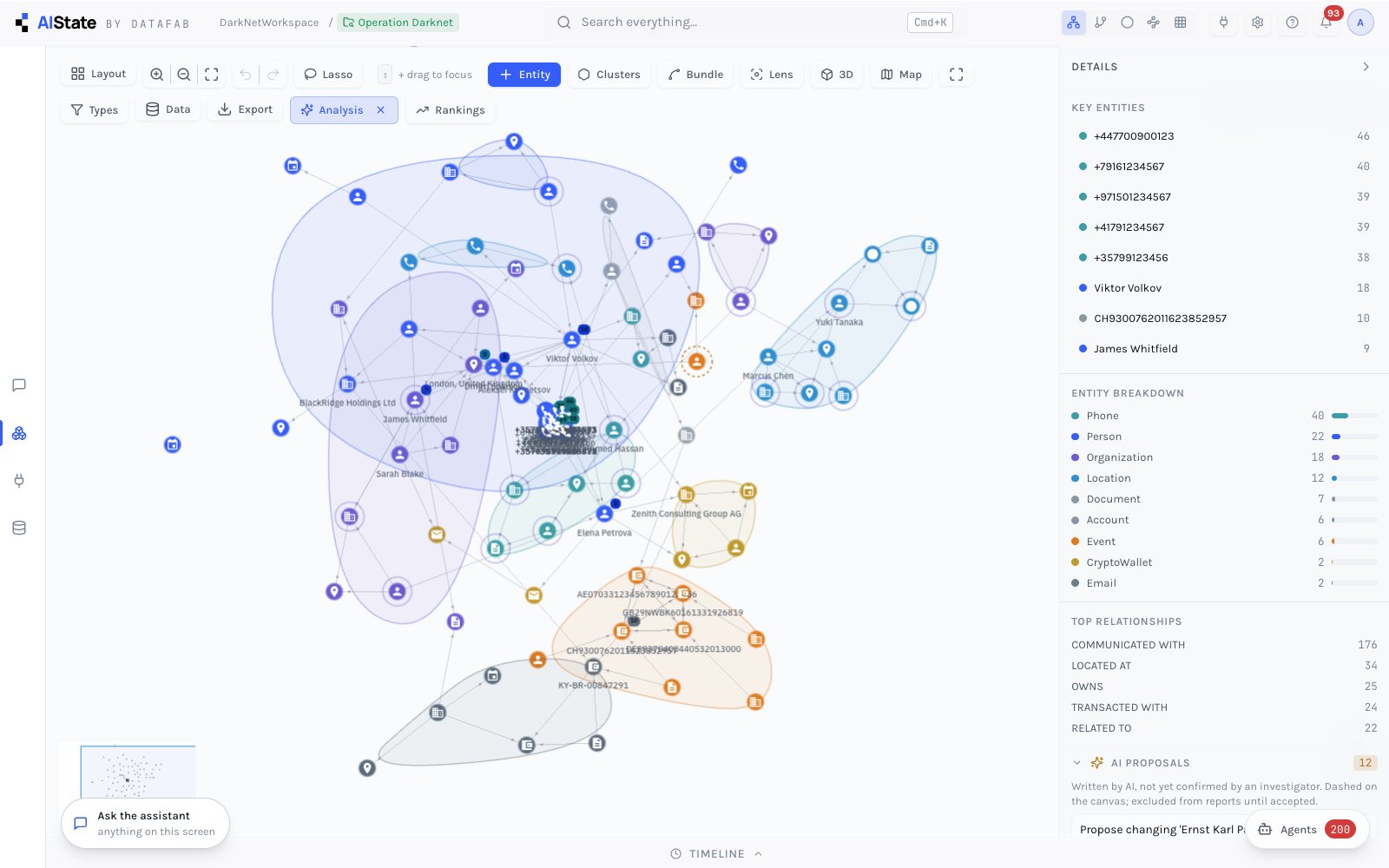
Databases, warehouses, object stores, document systems, ticketing, SIEM, streams and external feeds are read over named connections where they live. The Fabric discovers every asset, samples its schema, proposes entity types, tracks lineage and runs quality checks — nothing is catalogued by hand, and no rows leave those systems to build it. Then it does the thing a warehouse catalogue cannot: what those systems hold is resolved into one knowledge graph, and flat rows become multi-dimensional — the same customer, account, device or wallet is one object wherever it was read from, carrying its relationships, explicit and inferred. A structure you can traverse, and the canvas draws it as a whole.
How the Knowledge Fabric works → · ▶ Watch the IT-team walk-through
Two different things get called "data", and conflating them is how vendors end up owning an estate they were only asked to read. AIState reads your systems where they live. What it keeps is the work your people and their agencies produce on top of them — on your infrastructure, under your keys, yours to export or erase.
All of it inside your boundary · exportable as JSON, CSV, NDJSON or STIX · deletable on your word.
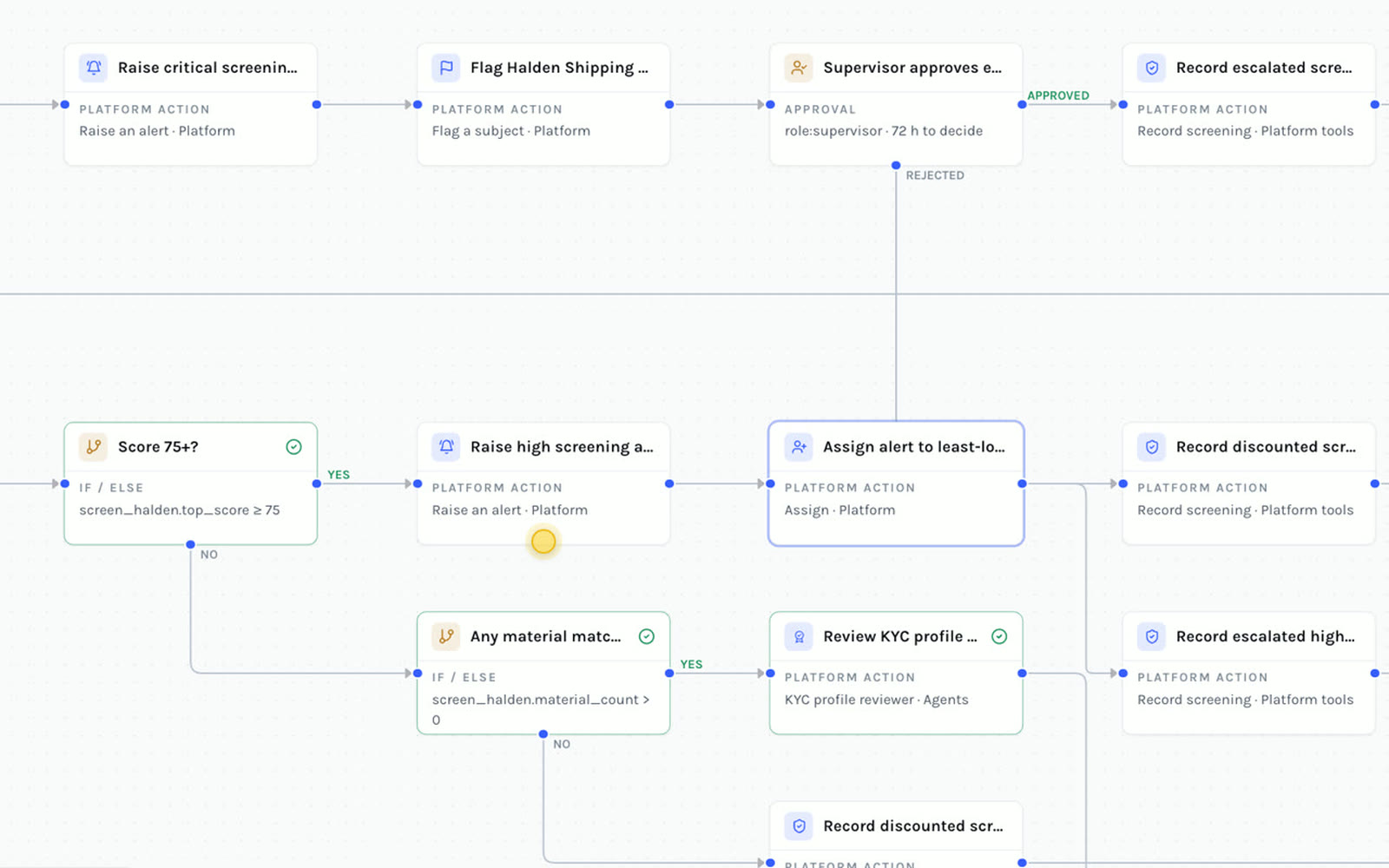
105 ready agencies — 84 across twelve disciplines (enrichment, risk, analysis, financial, communications, OSINT, legal process, case operations, reporting, triage, cyber, human intelligence) and 21 that run on a schedule or an event — and a Studio where your own people write theirs down in words, not code: purpose, the context it may read, the tools it may call, the shape of its answer, what it is allowed to change. Chains link agencies with deterministic tool calls, conditions, parallel steps and approval steps into procedures that run on a schedule or on an event. Agentic widgets answer in place — a diagram, a table, a map, a live screen — filed as an exhibit in one click.
The Studio, chains and autonomy → · ▶ Agencies in depth — the Studio, templates, chains, automation (9 min)
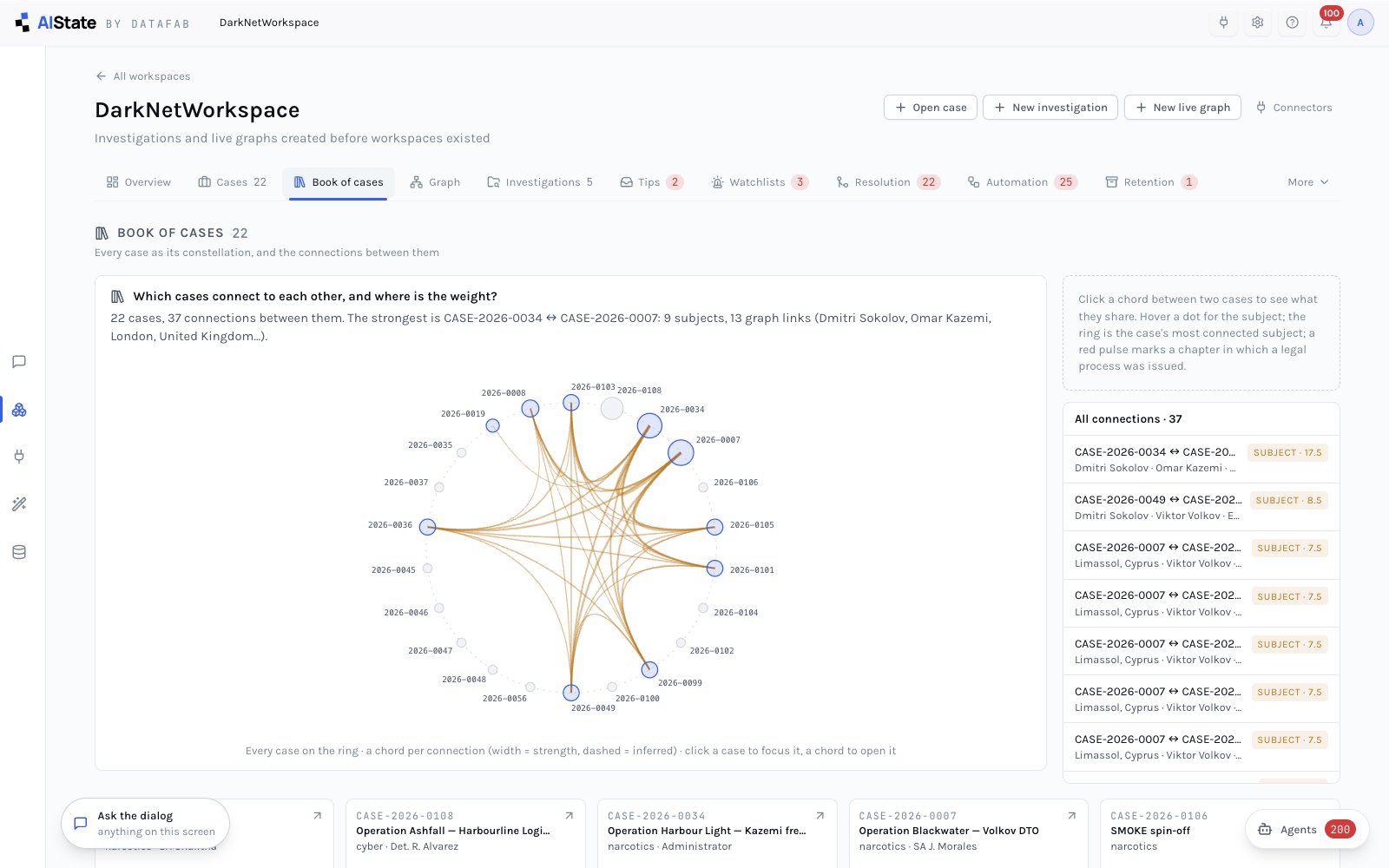
The canvas draws the knowledge graph itself — not an extract of it. Investigations render while they load; communities, betweenness, PageRank, shortest paths, timelines, maps and 3D sit on the same canvas. Live monitoring graphs take streams, webhooks, MCP pushes and file imports through visual pipelines — filter, route, alert, dedupe — held inside your boundary with the retention you set.
The canvas, screen by screen → · Live graphs and pipelines →

Shown on synthetic and public data.


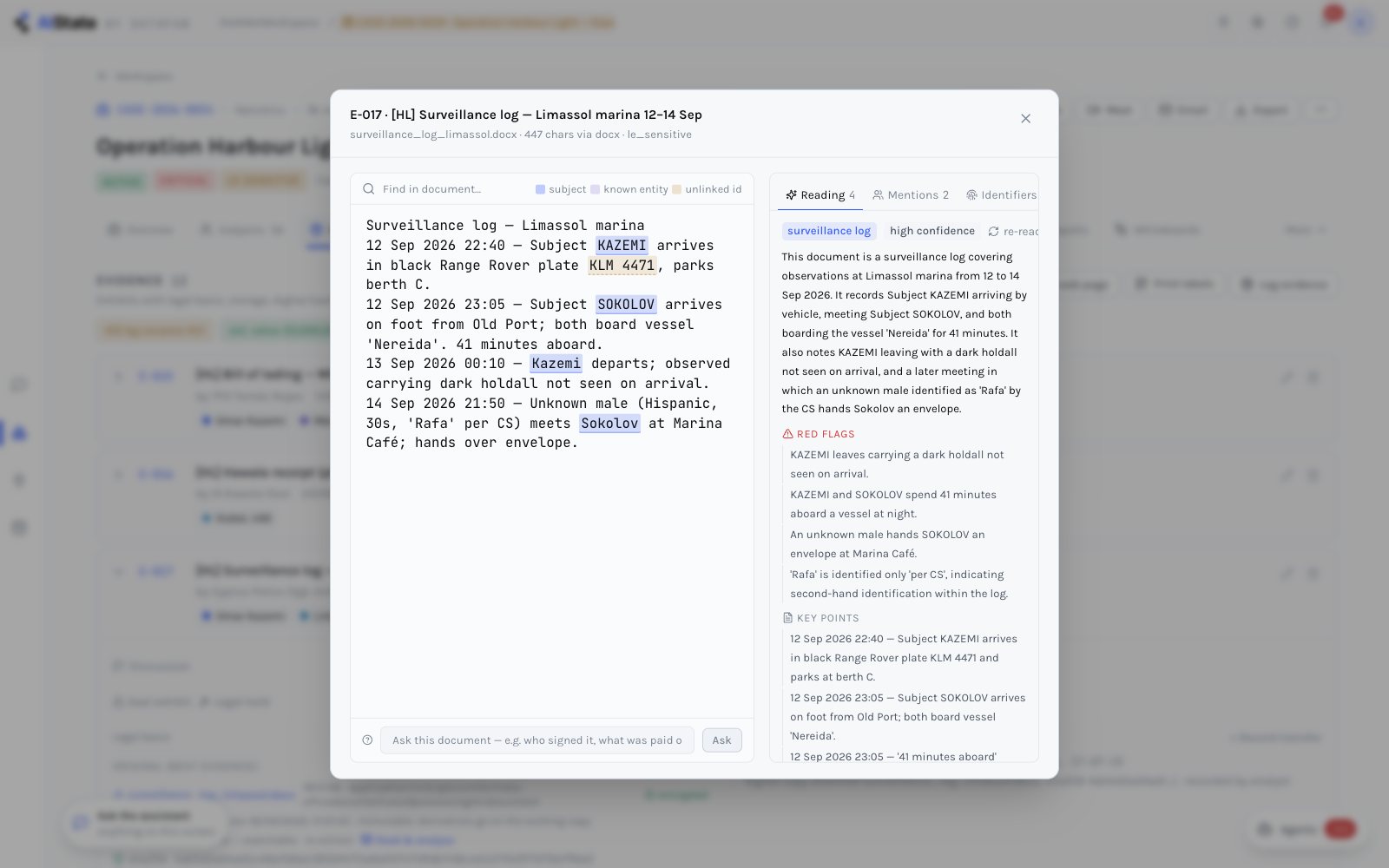
Subjects, evidence with chain of custody, regulatory reports, tasks, deadlines, recoveries and holds, restricted sources, BPMN workflow — a hash-chained audit trail behind every tab.
Originals immutable, encrypted at rest, re-hashed on every download. Pages, highlights and drawings on the original, four AI readings with citations, compare, versions.
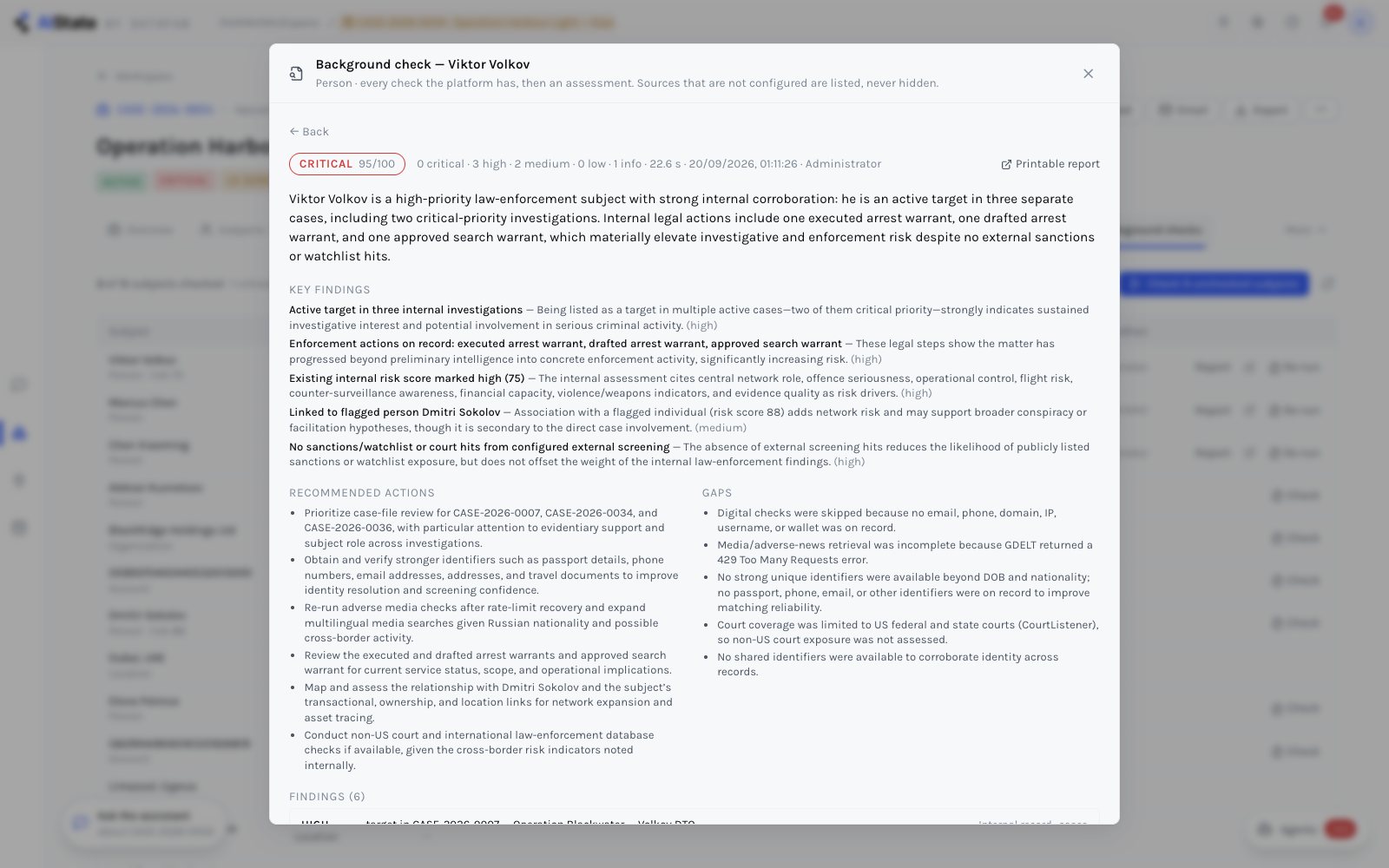
Profiles, duplicate detection and merge, one-click background checks across seven sections — graded and printable — and enrichment agencies per entity type.
Permissions rather than roles, clearance and case grants, workspace access, data boundary per model, session lock, MFA and SSO, accreditation evidence computed from the live system.
Playbooks on import or on a new subject, subject policies that re-run agencies and record every material change, batch screening on a schedule, watchlists that deconflict across cases.
Call detail records, bank returns, device extractions, chat exports, network, access, mail and forensic logs import into the graph and stay as rows: toll analysis, a transaction ledger with structuring and pass-through flags, cell sites and pattern of life.
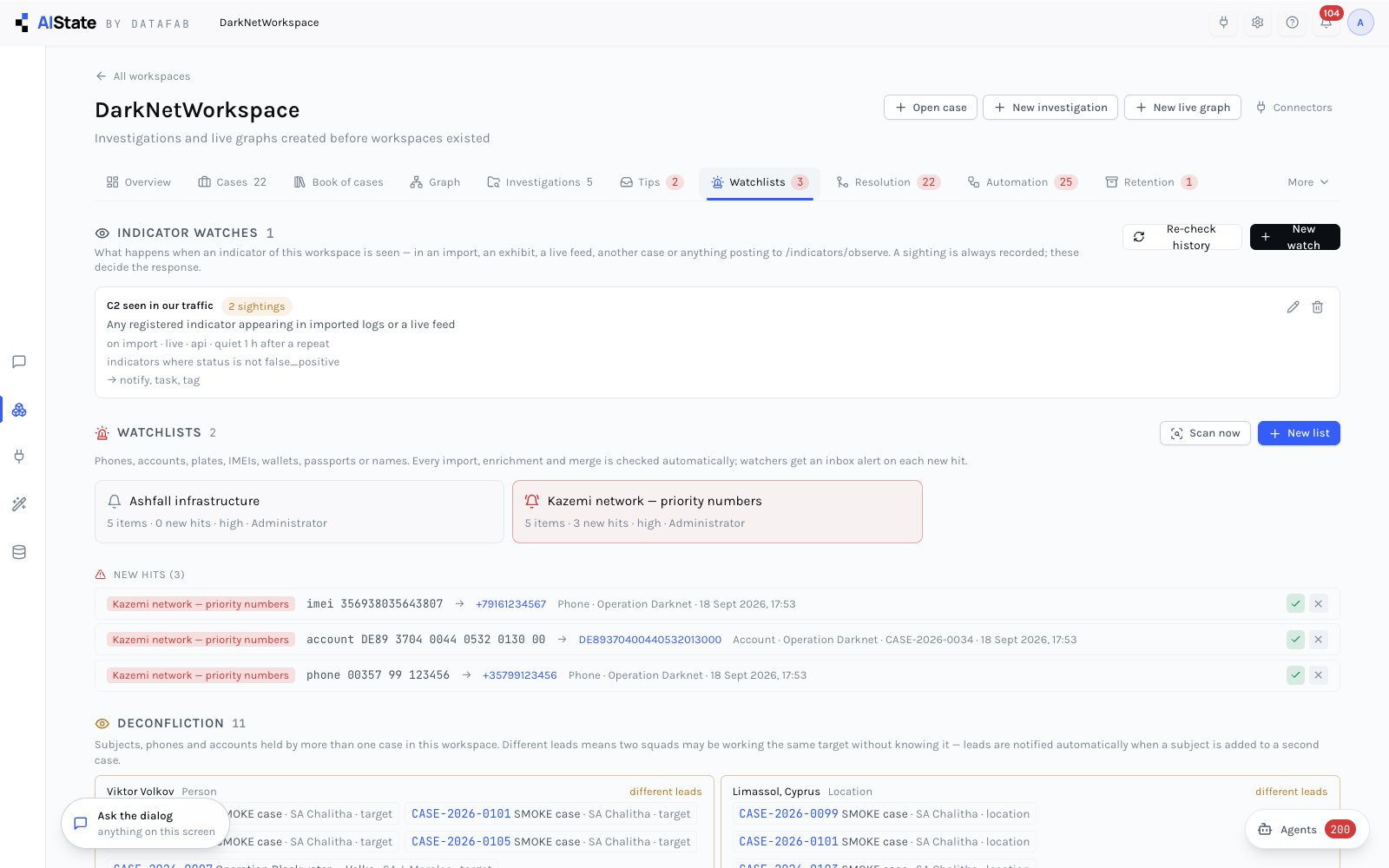
An indicator register with kill chain and ATT&CK; every value the platform reads — imports, evidence text, live events, your SIEM — checked against it, and a sighting recorded. Watches you configure decide the response. Statutory notices, RFIs and seized assets keep their own registers.
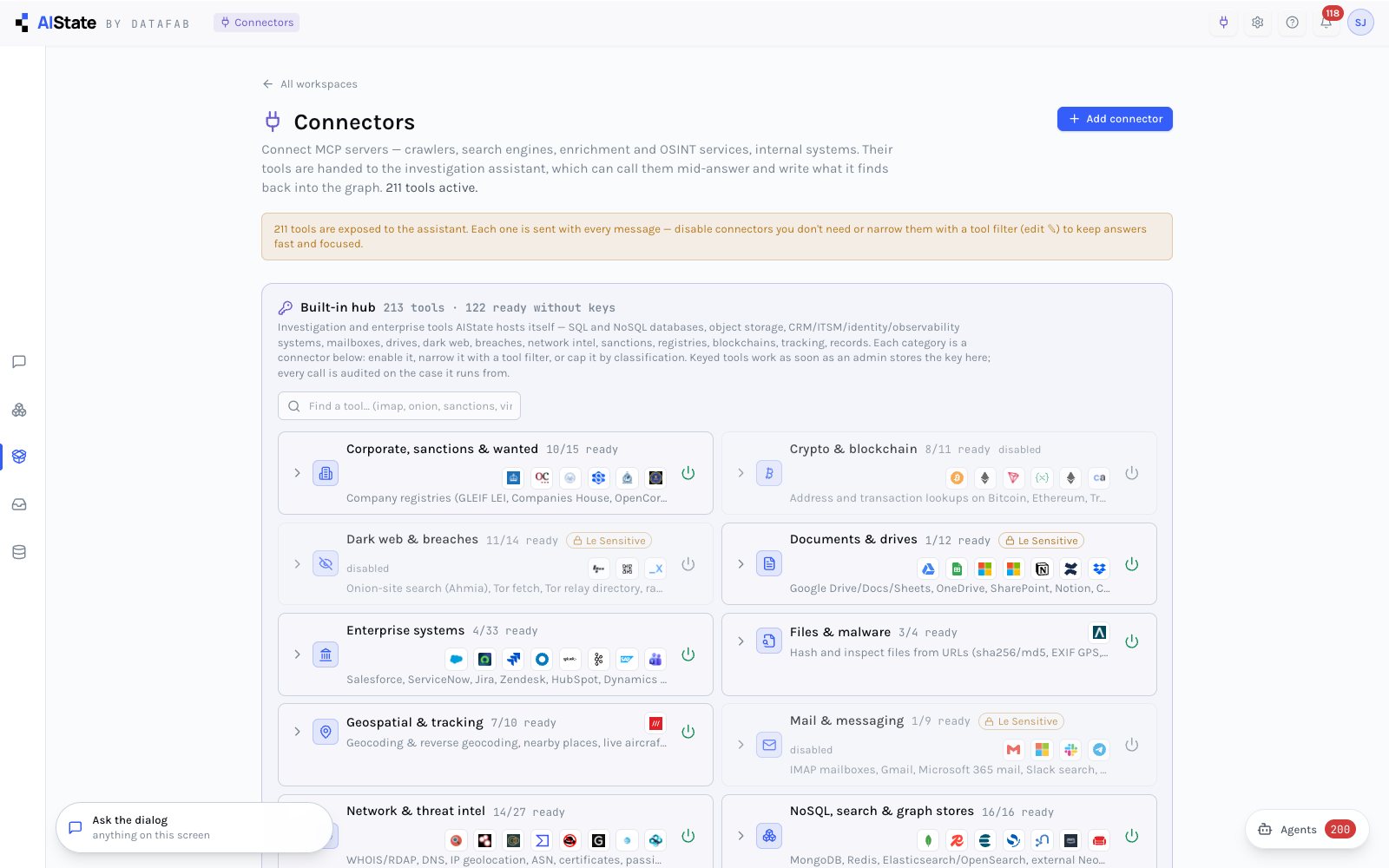
A built-in hub of investigation tools and read-only connectors for the systems you already run; a catalogue of external servers to register; the platform itself exposed as an MCP server for your feeds.
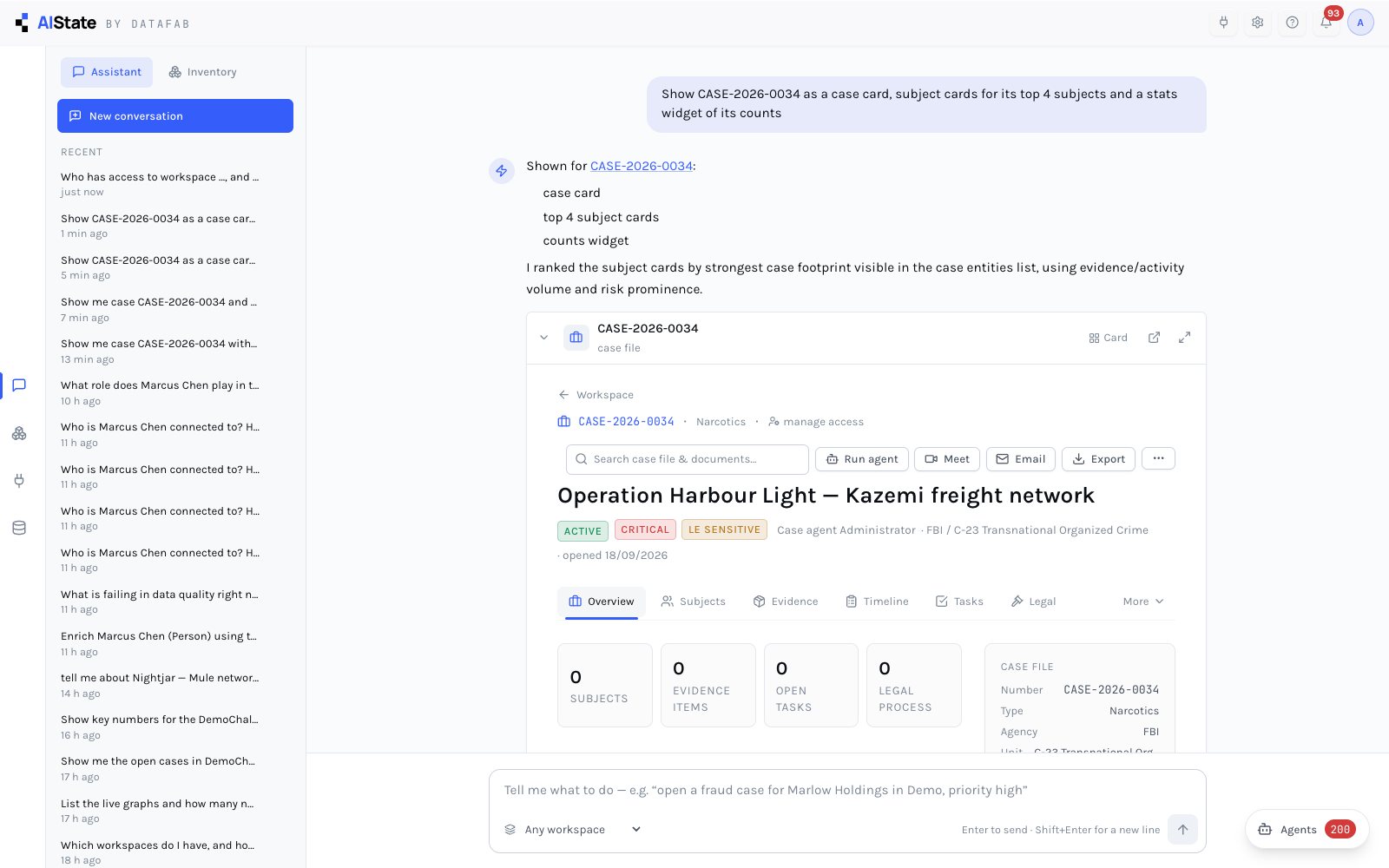
One chat bound to the record you are on — case, investigation, subject — that finds the right operation in the platform's own API, runs it as you and answers with cards, tables, maps and embedded screens.
Agencies and the dialog answer with diagrams, networks, flows, heat maps, timelines, org charts and correlations — any of them filed as an exhibit in one click.
Everyone can buy the same AI. No one else can buy what you know. AIState does not train on your data — what it resolves becomes your Artificial Proprietary Intelligence.
What accumulates as you use it — resolved entities, relationships with their basis, institutional memory, encoded expertise, governance context and current state — is an asset no vendor can license to anyone else. General capability is rented; proprietary context is owned, and it compounds every time a governed result is kept.
If you stop using AIState you keep the asset — resolved entities, relationships with their provenance, decision records and the policy you encoded — exportable in open formats (JSON, CSV, NDJSON, STIX) through the same API the platform uses.
Your systems stay where they are and keep their owners; the Fabric reads them in place and the state graph is the view over them. What you file and monitor is held inside your boundary, under your keys. Agencies your own people compose. Any model, under a data boundary you set per provider — your premises, government cloud, or a commercial endpoint you approve. Weeks, not quarters; no migration; no dependency on a vendor's ontology or engineers.
Compliance, AML, Fraud and Cyber are one problem seen from four desks — the same customers, counterparties, devices and accounts, split across systems that do not agree. AIState Risk is the product on that surface: detect, triage, investigate, act and report on one resolved graph, with agencies acting within your policy and approval wherever your authority matrix reserves the decision.
Indicator registers and watches; every value the platform reads is checked against them and recorded as a sighting.
The records a decision rests on — comms, ledgers, devices, logs — imported with their profile detected and kept as evidence.
Communities, centrality and paths over the resolved graph, every attribute carrying its source and confidence.
Case files, two-person approvals, regulatory output and a hash-chained trail a regulator can replay.
A utility is the same three layers pointed at one job — the domain lives in the ontology, the logic, the processes, the sources and the semantic context — authored as configuration, not built as new code. Three utilities run on it today: AIState Risk™ · AIState Compliance™ · AIState Real Estate™.
Each stage against market-standard cost.
Weeks, not quarters — read in place, with no migration programme.
Your people and your partner compose it. No standing team of vendor engineers.
Depending on volume — the agencies carry the work, people take the decisions.
Systems of record were never touched. Export the identity layer, policy, decisions and audit trail.
Illustrative. Run reduction varies with volume; every figure is validated against your own estate in the proof of value.
Narrated walk-throughs recorded from the running platform. Chapters seek the video; each carries the narration and what to look for on screen.
The dialog answering with live widgets, the case file, the graph with communities and centrality, live threat-feed capture, MCP enrichment with provenance, a background check, sealed evidence and indicators, agencies through the review queue, the BPMN workflow.
The estate catalogued in place with lineage and quality checks, enterprise connectors, your schema and custom entity types, the model registry with a data boundary, identity and access, accreditation evidence computed live.
Everything a team runs under one roof — investigation graphs, live monitoring graphs, cases, tips, watchlists, screening, collections — with a Context-Aware Dialog bound to the record in front of you: it runs the actions rather than advising from the side, with agencies and chains behind it, and files each thread in the case's chat log.
One place to browse, build, chain, test and publish: a library of ready agencies and chain templates, an agency's anatomy on a canvas, a live run with its execution trace, analytics per agency, Plan with AI from a sentence, chains with tool steps, conditions, parallel branches and approval steps — every write governed by policy, with two-person approval on the decisions you reserve.
105 agencies ship ready — 84 specialists across twelve disciplines and 21 that never go off shift. They know the work: screen a subject, read a ledger, map a network, grade a source, draft the report. Each one reads only the case it is cleared to see, decides what to look up next, checks its own answer and acts within your policy. It hands a person only what policy reserves. Your experts add their own in plain language.
Agencies inside · approval where you reserve it · all recorded
What an agency actually is, and all 105 of them →
Watch an agency built, chained and run → · How agencies are governed →
The Model Context Protocol is how the dialog and the agencies reach anything outside the graph. We host a hub of investigation tools in-process, read your own systems over named read-only connections, register any external server you trust — and expose AIState itself as an MCP server so your feeds can push straight in.
Runs inside your deployment, not ours. Network & threat intel, corporate registries and sanctions, crypto, people and professional profiles, geospatial, web, news and archives, social, mail, documents, files and malware, public records — grouped into families, each tool read-only and rate-friendly.
SQL warehouses and databases, document and search stores, object storage and file shares, and the SaaS your teams already run — reached over named connections that are validated read-only, statement by statement, with row caps and an egress boundary you set.
Register a server by URL, discover its tools, and filter which of them the dialog may see. Each connector carries a classification, so it is withheld from cases above it.
Point your own agencies, pipelines and feeds at the platform: push events, upsert nodes and edges, delete — straight into a live monitoring graph, through the same pipeline filters and the same audit trail as everything else.
Plus the open sources the investigation tools speak to — company registries and sanctions lists, RDAP and passive DNS, CVE and ATT&CK, blockchain explorers, court records, news archives and more.
See the hub and the connector screens → · Where it is configured →
Hash-chained audit per case, anchored daily. Evidence encrypted at rest with the original immutable. The NIST 800-53 control baseline the platform touches, assessed against your deployment on every load, with the actions that close each gap. FIPS path, SBOMs, session lock, MFA and SSO for four identity providers.